Most people think about land investment the way they think about a hunting camp: a nice-to-have, not a core financial decision. The numbers tell a different story. Across the Mid-South, rural land — farmland, timberland, and recreational ground alike — has quietly become one of the more compelling asset classes available, and it’s worth understanding why before you write it off as sentimental rather than strategic.
The case for land as an asset class
Farmland isn’t a niche curiosity in a portfolio; it has a real, measurable track record. The NCREIF Farmland Index, which tracks institutional-quality U.S. farmland returns, has averaged roughly 10 percent annualized returns since 1990 — with annualized volatility of about 6.8 percent, compared to roughly 17.6 percent for U.S. stocks. In plain terms, farmland has delivered stock-like or better returns with a fraction of the bumpiness. It has also shown weak to near-zero correlation with stocks and bonds, meaning it tends to move independently of the broader market. During the 2008 financial crisis, while the S&P 500 was posting steep losses, the NCREIF Farmland Index recorded modest gains. That kind of behavior is exactly what a diversified portfolio is supposed to have more of.
Land also does something few other appreciating assets do: it pays you while you hold it. A row-crop lease, a timber harvest, a conservation program payment, or a hunting lease can all generate income in a given year, independent of whether the underlying land value goes up. Try getting a dividend like that from a vacant lot or an ounce of gold.
The regional picture: four states, four different stories
The Mid-South isn’t one homogenous land market, and that’s part of the appeal — it gives an investor real diversification within a single region.
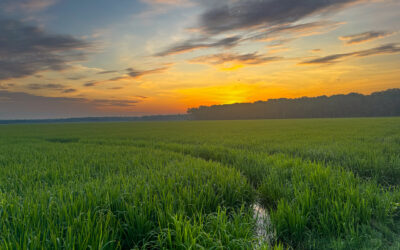
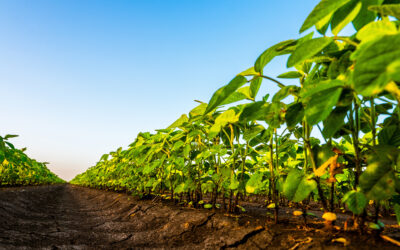
Arkansas cropland values have climbed steadily, from $3,330 per acre in 2022 to $3,850 in 2026, a compounding gain of roughly 3.7 percent a year with no down years in that stretch. The Grand Prairie counties — Jefferson, Arkansas, Lonoke, and Prairie — carry a premium above that state average because they offer something few other row-crop regions can: rice-and-soybean farm income stacked on top of some of the best duck hunting ground in North America. That dual revenue stream has historically provided real insulation when either crop prices or hunting demand soften on their own.
Tennessee posted the largest percentage gain of any state in the country in 2026, with cropland values up 5.8 percent to $6,400 per acre — nearly double Arkansas’s average. That premium reflects Tennessee’s growth-market dynamics: proximity to Nashville and other expanding metro areas puts non-farm buyer demand and development pressure underneath agricultural land values in a way that pure row-crop states don’t experience to the same degree.
Mississippi cropland sits at $4,060 per acre for 2026, and the state’s rural land market leans heavily toward timberland and recreational acreage — historically around three-quarters of Mississippi’s rural land transactions have involved recreational or timberland rather than pure row-crop ground. Combined with a stabilizing outlook for southern pine sawtimber prices and growing institutional interest in timberland as a “natural capital” asset class, Mississippi offers a genuinely different risk and income profile than a pure grain operation.
Louisiana cropland has grown to $3,660 per acre, the most affordable entry point of the four states, with a market outlook that’s steady overall and showing particular strength around industrial corridors and high-demand recreational zones. For buyers priced out of Arkansas or Tennessee ground, Louisiana often represents the value play in the region.
The tax and policy environment is unusually favorable right now
A few things have lined up to make this a good moment to own rural land in the Mid-South specifically. The federal estate tax exemption jumped to $15 million per person ($30 million per couple) starting this year and was made permanent, removing what used to be a real threat of forced land sales to cover a tax bill at generational transfer. Agricultural land also continues to qualify for “special use” valuation in many estates, meaning it can be valued at its agricultural worth rather than its highest development value for tax purposes — a meaningful advantage over other real estate classes. And conservation programs like CRP, freshly reauthorized for five more years, give owners of marginal or wetland-adjacent acreage a straightforward way to generate stable income while improving the land’s ecological and recreational value.
Being honest about the risks
None of this means rural land is risk-free. Commodity prices swing — Arkansas rice growers are living through a genuinely hard year right now, with prices down sharply on a global oversupply out of India. Financing costs and interest rates affect what buyers can afford to pay, and land isn’t a liquid asset; you can’t sell 10 acres of a 500-acre farm on a Tuesday afternoon the way you’d sell a stock position. Water rights, easements, mineral rights, and title issues all require real diligence before closing. Land investing rewards patience and homework, not speculation.
The takeaway
Rural land across Arkansas, Tennessee, Mississippi, and Louisiana offers something increasingly rare: a tangible, income-producing asset with a strong long-term track record, low correlation to the stock market, and — right now — an unusually favorable tax environment for holding and transferring it. Whether you’re drawn to Arkansas’s rice-and-duck dual income, Tennessee’s growth-market appreciation, Mississippi’s timberland stability, or Louisiana’s value pricing, the fundamentals across the region support a longer look than most investors give it.
Curious what a diversified rural land position could look like across the Mid-South? Talk to Lile Real Estate — we’ve spent more than 30 years matching buyers with farmland, timberland, and recreational ground across Arkansas, Louisiana, Mississippi, and Tennessee.